Mr. Flamingo, Mr. Featherstone, Mr. Pink and Ms. Sitherwood all in an Avian Mating Dance Orgy

Flamingos are one of the more recognized avian species in popular culture.  Whereas the bald eagle is synonymous with courage and nobility, the flamingo is a bit more mysterious and is often associated much less stoic characteristics.

The Flamingo hotel, for example, is the longest standing (and probably cheesiest) hotel on the famed  Las Vegas strip. Afterall, it is decorated with pink shag carpets and a live wildlife habitat featuring the namesake birds.

“Pink Flamingos” was a low budget movie directed by John Waters, the odd director who brought us the original cult classics “Hairspray” and “Serial Mom” was notorious for working  with even stranger actors and actresses like Divine, Traci Lords and Ricki Lake.

Although not entirely related, when I heard the name of the restaurant I couldn’t help of think of Mr. Pink in Reservoir Dogs .  In what I would argue is  the most famous Tarantino restaurant scene after the five-dollar milkshake in Pulp Fiction, Mr. Pink, played by Steve Buscemi, goes on a rant about the concept of tipping, arguing that it should not be an automatic gesture (he must have visited a few places in Toronto’s west end along his travels).


On the small screen, flamingos,  along with other Florida vestiges such as fancy cars, jai alai, dog racing, beaches and boobs were prominent in the iconic opening credits of Miami Vice.  Speaking of televisions shows, the short lived prime-time soap opera called Flamingo Road starred Morgan Fairchild and Mark Harmon dealt with the frantic and fast-paced lives of elite Floridians.

All of this said, perhaps the most recognizable use of the pink flamingo in popular culture is the plastic lawn ornament.  Primarily used to signify key life events (like a 50th birthday let’s say), this tacky accessory was first produced by Don Featherstone , an employee of the union plastic company in Massachusetts.  This achievment was significant enough to have him recognized  in a New York times obituary the day after his June 22, 2015 death.  Here are a few interesting facts about the pink flamingo:

  • They were initially offered in the late 50’s sold for $2.76/pair in the Sears catalog.
  • In 1999, the city council of Madison, Wisconsin voted the plastic flamingo, coined Phoenicopterus ruber plasticus by Featherstone himself, as the city’s official bird.
  • In the 2011 Disney film “Gnomeo and Juliet”, there is a flamingo named Featherstone which is an interesting twist given the well- established competition between the gnome and the pink bird for cheesy lawn ornament supremacy.

Probably the oddest use the Flamingo is the Quebec food company whose catch line is “an excellent source of fun”.  First, the primary foodstuffs produced by the Flamingo company are poultry products which is just weird.  Second, I don’t equate the consumption of chicken burgers as fun, yet alone an excellent source of it.

All of this said, I can only speculate as to the rationale behind Mr. Flamingo’s name.  I think some would  speculate that the bird symbolizes the simple yet swanky theme of the restaurant.  The menu consists of small plates which in many cases contain upper echelon foods such as oysters, fois gras and truffles.

Although, I would almost expect a cocktail to be named after Mr. Featherstone ,I couldn’t find one so I ordered the bourbon based Ms. Sitherwood ($14) instead.  The first page of a google search identified Ms. Sitherwood as the  Chief Executive Officer of The Laclede Group although I have no idea if that’s relevant at all.    It was served in a dainty glass adorned with mint leaves. The general vibe of the drink was a sophisticated but not mind-blowing  long island ice tea ($14).

2201
Ms. Sitherwood $14

Before I go into the food choices, let me say that the staff were extremely accommodating.  The menu prices listed on the web are for a specific portion but they were more than happy to modify the portions and prices in some cases (eg. oysters and scallops) so that everybody had at least one piece.  Futhermore, they split the bill in 5 and printed one out for each of us.  These things seem simple  but can be surprisingly hard to find among  many Toronto eateries.

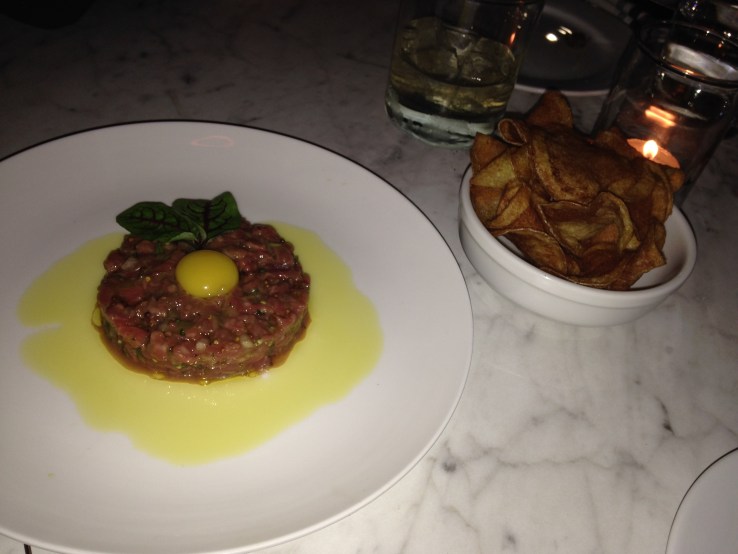
Since we had a fairly large table, we were able to order most of the menu.  First on the list was the steak tartare ($14) served with a quail egg and chips.  It had a symmetrical and pretty appearance and its moderate spice was driven more by pepper than other heat sources.
2202
Steak Tartare with chips $14

The burrata ($16) was served with a gorgeous  tomato salad. The cheese was seasoned nicely and had a beautiful texture similar to that of a soft boiled egg; firm on the outside and runny in the middle.

2203
Burrata $16

The lobster based oysters ($3.50/piece) wouldn’t have been my first choice but they fit the swanky theme of the place.  The lobster hollandiase had a sweetness and creaminess which nicely offset the salty and not over-cooked oyster, making  it a decent bite.

2204
Lobster Baked Oysters $3.50 each

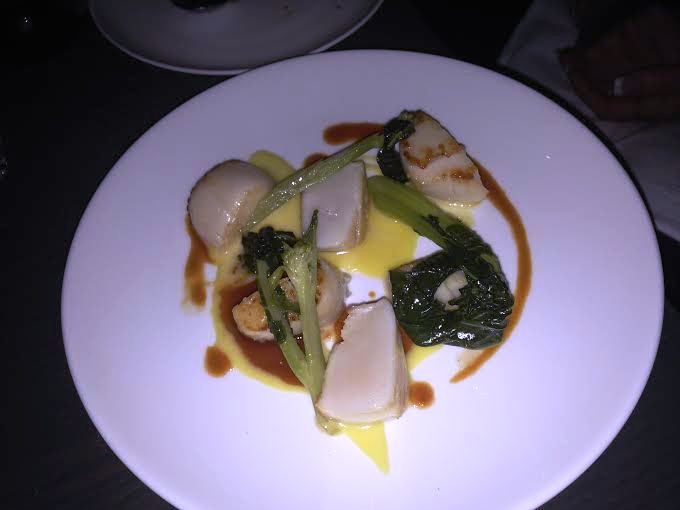
Based on other reviews, the scallops with popcorn puree and sea asparagus ($22.50 as shown) could very well be their signature dish. It hit all the elements of such a dish; the scallops were cooked properly, the puree was divine and the sea asparagus added the colour, texture and taste needed to balance everything out.

2205
Scallops with popcorn puree and sea asparagus ($4.50 each)

The trout  was another tasty dish but  at this point the menu was getting a bit monotonous as many of  it’s elements were near identical to the previous two (oysters and scallops), adhereing to the theme of well cooked protein plus rich sauce plus green vegetable.

2206
Trout

On paper, the mushroom risotto topped with shaved truffle may have been the  pinnacle of Mr. Flamingo’s swanky small plate experience.  Although I’m not generally a risotto fan, I appreciated the avoidance of truffle oil as an excuse for fancy flavoring.  It was a nicely prepared dish but was still highlighted by rich flavours similar to many other items on the menu.

2207
Mushroom Risotto

The duck and steak were both nicely prepared but not unlike anything you can get at any other restaurant in the area.  It seems almost mandatory that these dishes appear on menus, prepared and seasoned the same way and served alongside the rather predictable sides.

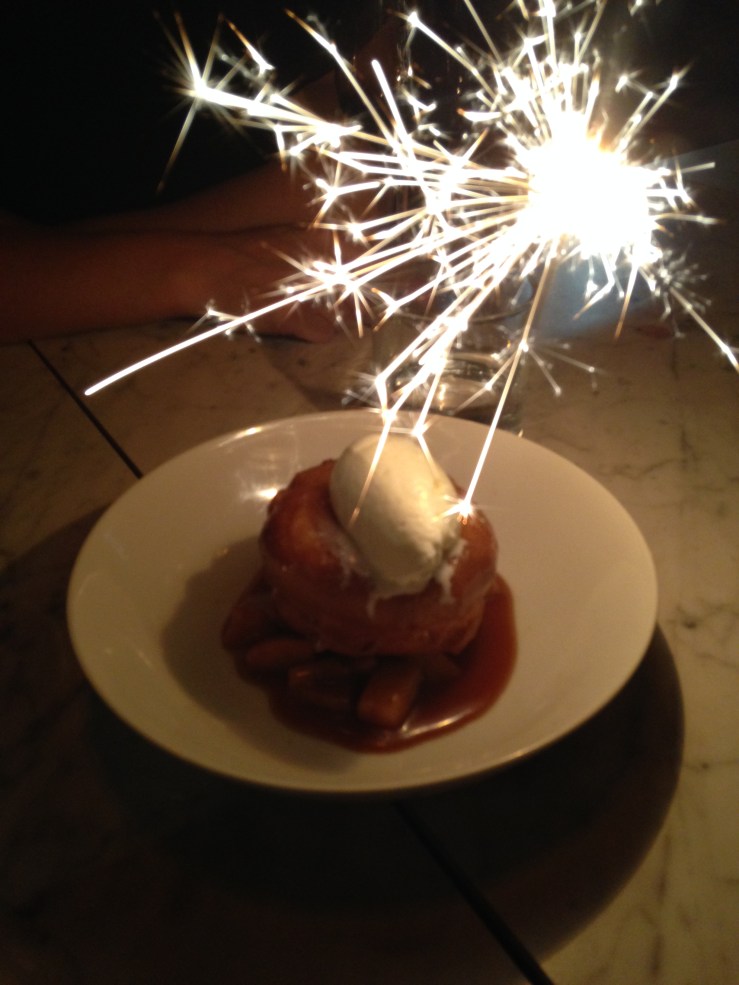
After a meal in a place named after a suave and sexy bird serving oysters and  truffles,  I expected some kind of lavish desert. Instead, the sole offering was a donut with a sparkler in it.  It was a rather carnival ending to an otherwise posh meal.
2211
Donut with Sparkler $6

My Take

I may have missed my calling as an ornithologist so I’m never upset when I can eat at a place named after a feathered friend (yes I must admit I like eating some of them as much as I like watching them). After my dining experience, I can’t say I was as excited as the majestic flamingo during its mating ritual but it was still a decent meal.


Mr. Flamingo offers a mix of the standard sharing plates seen in a lot of the area’s eateries with the addition of a few unique ones, in particular the scallops with popcorn puree. In general, the majority of the menu is a bit monotonous in flavour though. Overall,  it was a good experience, highlighted by above average service starting with the fact they will actually split a bill, a fact that may even convince Mr. Pink to throw a few bucks on the table after all is said and done.
Mr Flamingo Menu, Reviews, Photos, Location and Info - Zomato

Hanmoto: May possibly be the Crown Royal Northern Harvest of New Toronto Restaurants.

The faceless Chris Nuttall-Smith just published his top 10 new Toronto restaurants.  Not surprising, Alo tops the list and other clear favorites including Buca Yorkville and Dandylion made the cut as well.  Perhaps a little more surprising was the inclusion of Hanmoto, the little and unorthadox izakaya joint hidden just outside the intersection of Dundas and Ossington  (it’s on Lakeview Avenue however which, like the Lakeview Diner a block away, doesn’t have a view of a lake).

As Mr. Nuttall-Smith writes (in words much more eloquent than mine), it has no sign and has the aura of a flea market where you are not sure if you will get a great deal, bamboozled  or stabbed with a sushi knife.  The menu is as primitive as the make shift signs you would see advertising dollar persimmons along Spadina avenue.

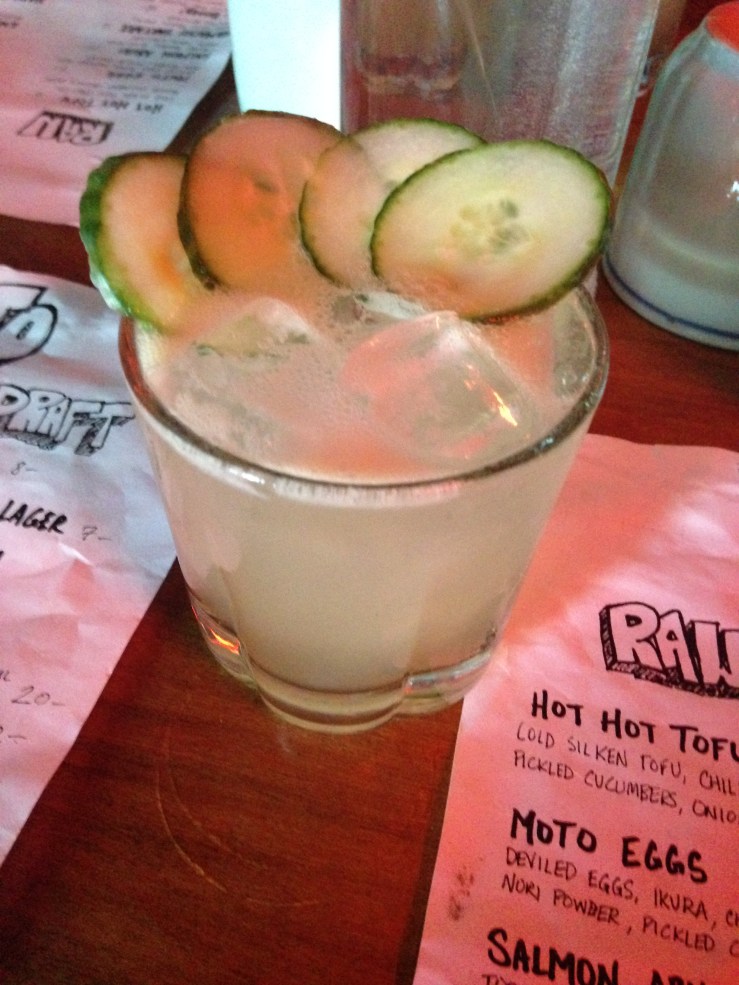
I went with a few friends a while back as stage one of an Ossington food crawl.  Arriving at 530 or so ensured that there no wait for one of the few makeshift tables scattered among the curio-filled hollow .  The waitress was a pleasantly non-nonsense woman who had a fantastic grasp of the small menu. It seemed fitting to start with the somewhat famous arisaka sour, a gin based cocktail flavoured with yuzu, green tea and cucumber and finished with soda and lime bitters.  It was quite refreshing but a bit flimsy so it was evident I had to switch to beer to avoid downing 8-10 of them before the end of the meal.

2134 - Copy
Arisaki Sour $12

The tiny menu meant little deliberation and the table agreed on the hamachi tartare, the moto bun, the enoki, the masu dengaku, okra and famed dyno wings .

The tartare was nicely balanced from both a texture and taste perspective and was served at the correct temperature.  The moto bun was a fun and flavourful twist on a sloppy joe and was next to impossible to share with the table.  That said, I’m always appreciative of a bun that can withstand the assault of a sloppy filling for the duration of consumption.

The enoki with miso butter was a surprisingly simple take on those mushrooms you see at the Asian food marts and don’t know what to do with.  Their texture with, when combined with the miso butter is somewhat reminiscent of a fat laden piece of steak.

The masu dengaku was an oddly attractive eggplant dish made pretty with fried beets and seasoned with a delicious miso hollandaise.

Each of the previous dishes did not shy away on extreme flavours but the crispy okra blanketed with bonito flakes and asiago (a very saline and odd combination) was a miss.  We casually passed the dish around the table like a hot potato and there were no takers.

2136
Okra $8

Finally, it was time for the fame chicken dyno chicken wings served in the signature take out box.   These wings, stuffed with a pork dumpling, have already attained mythical status in snack food folklore and the label is deserving. The dumpling offers both stark contrast to the crunchy mouth feel of the deep fried wings yet both flavours are married with the sweet and salty sauce.

2140
Dyno Wings $8- A Hot Mess

My Take

I’m a sucker for a good gimmick and there are no shortage of them in the restaurant industry.  I was all over the  Yakatori bar on Baldwin (which now ceases to exist) and I’m the guy who rushes to Harvey’s after not going in years to get my hands on a somehwat revolting pop tart ice cream sandwich.   From the seedy surroundings to the focus on nothing by snack food, Hanmoto itself is a gimmick but one that gone from the exception to the rule in the hipster driven expanse with an Ossington epicentre.

It seems Mr. Nutall-Smith is also enamored by a good gimmick. In his review of Hanmoto, he forgives any hiccups (ie. farmed vs wild salmon) by saying that it’s not that type of bar.  It seems his opinions are driven by the fact that the booze drives the food and not vice versa which I disagree with given the rather sleepy cocktail list and predictable beer choices. Don’t get me wrong..he is brilliant writer and one of the first people I go to for an objective opinion on a new restaurant but I’m left wondering if including Hanmoto on the best new Toronto restaurant list is synonymous with Jim Murray’s choice of Crown Royal Northern Harvest Rye as the world’s best whisky.  Maybe I can meet him halfway but saying the dyno wing is one of the top 10 must-try new dishes in Toronto in 2015 but even in my relatively limited exposure to novel eateries, I won’t go as far as generalizing the dish to the entire experience.

Hanmoto Menu, Reviews, Photos, Location and Info - Zomato


Han Ba Tang- Still Drawing the Short Straw Years after Toughskins and Crooked Haircuts

I had a dismal month of blogging in November, primarily due to the fact that my real job gets in the way when it’s busy.  I hope December is better. Speaking of busy, the every day trails and tribulations of life lead one to fall into rhythms of the present.  Aided by facebook, which has seemingly rewound time and made friends of the past friends of the present, I made a commitment to myself to reconnect with some of these friends and personally I see no better way to do it than over a bowl or plate of something.

I was a small, quiet kid who had a crooked haircut and wore Toughskins, which were corduroy pants with reinforced knees meant to withstand the harsh treatment an 8 year old had to offer.  I didn’t understand why people laughed at “Taxi” and why that old man Edward Woodward was scary as “The Equalizer”.  I liked when my mom brought me to the hotel bar down the road from my grandmother’s house because I could eat all the maraschino cherries I wanted. I went to a tiny school in Sudbury so whether I liked it or not, I had to hang out with a small group of people…in Sudbury. I got the hell out as soon as I could and somewhat lost track of 90% of those in my past life until Facebook. Now, I have reconnected with historical figures in my life ranging from elementary school to university.

It seemed totally logical to meet a friend I haven’t seen in almost 30 years at Han Ba Tang, A Korean joint in North York (I keep thinking it’s called Hang Ten after the company with the big foot slogan that kids cooler than me wore although we lived no where near waves bigger than those made from a 20 HP motor on Lake Ramsey). What drew me to this place was not the easy to remember name ( I forget it every time) but the fact that it scores one of the highest ratings on Zomato. That and the fact that 2015 appears to be the year of Korean food in Toronto and I wanted to compare it to Korean Cowboy and other similar eateries scattered across the GTA.  Plus, we both decided that we should have something that didn’t exist in our Sudbury days where Asian food was limited to sweet and sour chicken balls at the Pagoda.

I arrived, went to the bar and ordered the Caesar on fire. The twist was the addition of jalapeno soju.  I was tempted to ask the bartender for ID since he acted like a teenager.  This perception was aided by the fact that he opened up a recipe book and meticulously measured every ingredient into a Steamwhistle pint glass only to realize after the fact that he had no straws long enough for the glass.   It was good but a full pint of caesar makes for a big drink so the flavours were somewhat diluted even with a short straw.

Caesar on fire with Jalapeno Soju $11

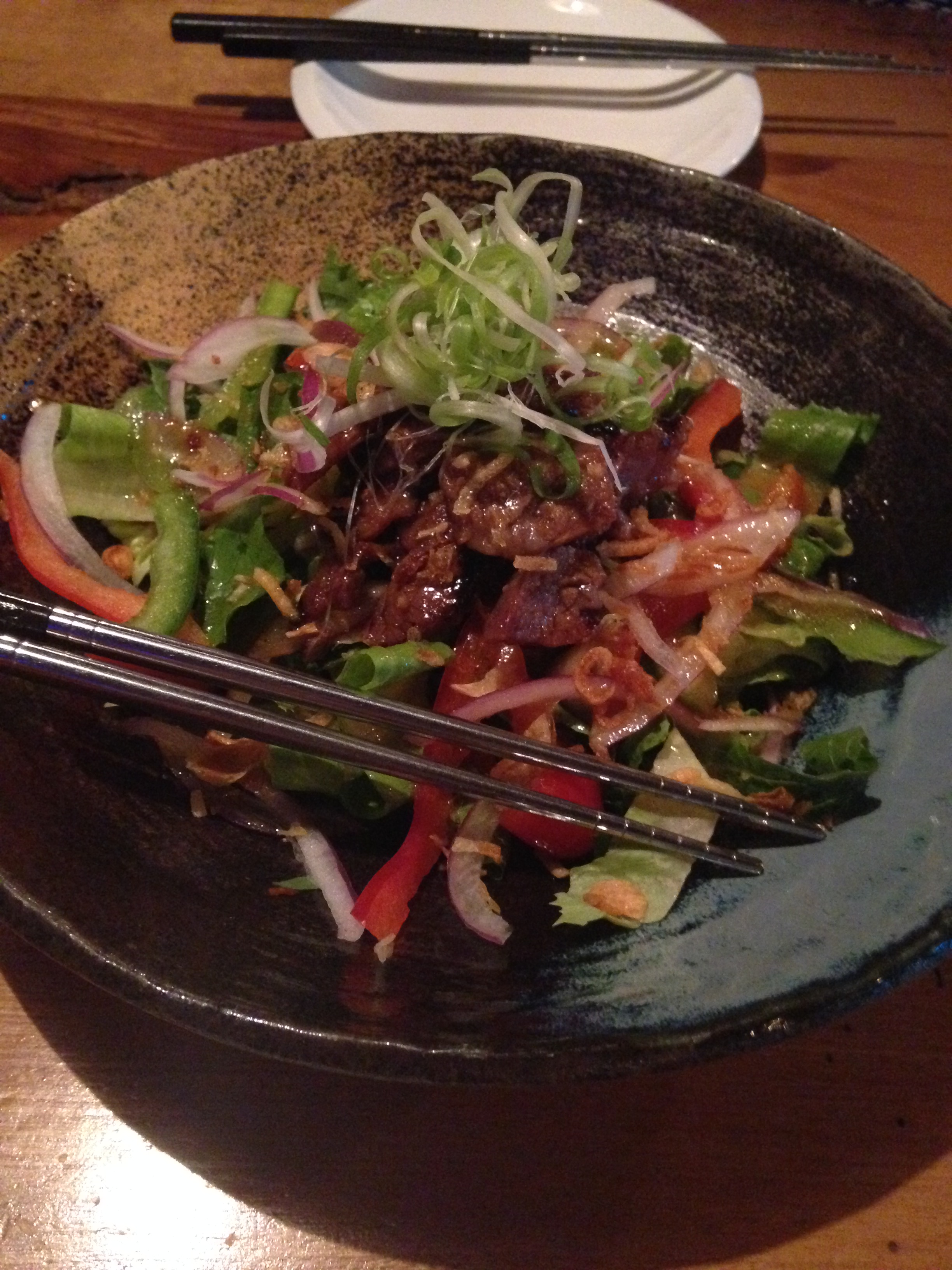
Dish one was the Kalbi salad ($10) which highlighted the short ribs in a forest of romaine, onions, bell peppers and an onion dressing. It was topped with some deep fried onion as well.

Kalbi Salad
Kalbi Salad $10

One cannot go to a Korean restaurant withour sampling the tacos so I ordered the spicy pork, kalbi and unagi trio.  The shells were oddly shaped and the fillings was flimsy for $4-6 bucks each.  Flavourwise, they were ok but overall the touted tacos were a bit of a let down.

Spicy Pork, Kalbi and Unagi Tacos

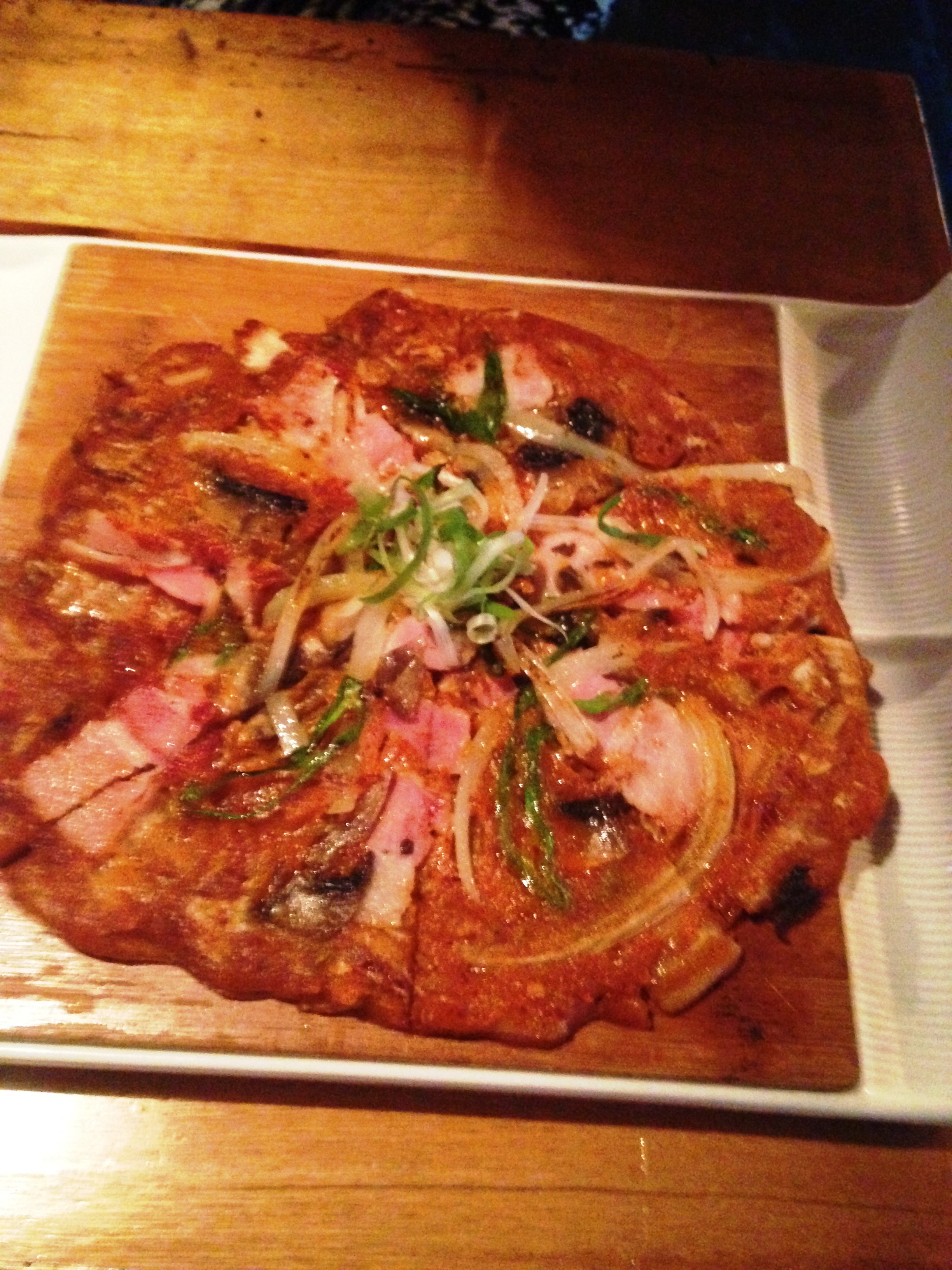
The kimchi pancake was fantastic.  Laced with bacon, mushroom and pepper it was browned perfectly which maximized both taste and appearance.  It had great textural contrast as well.

2127

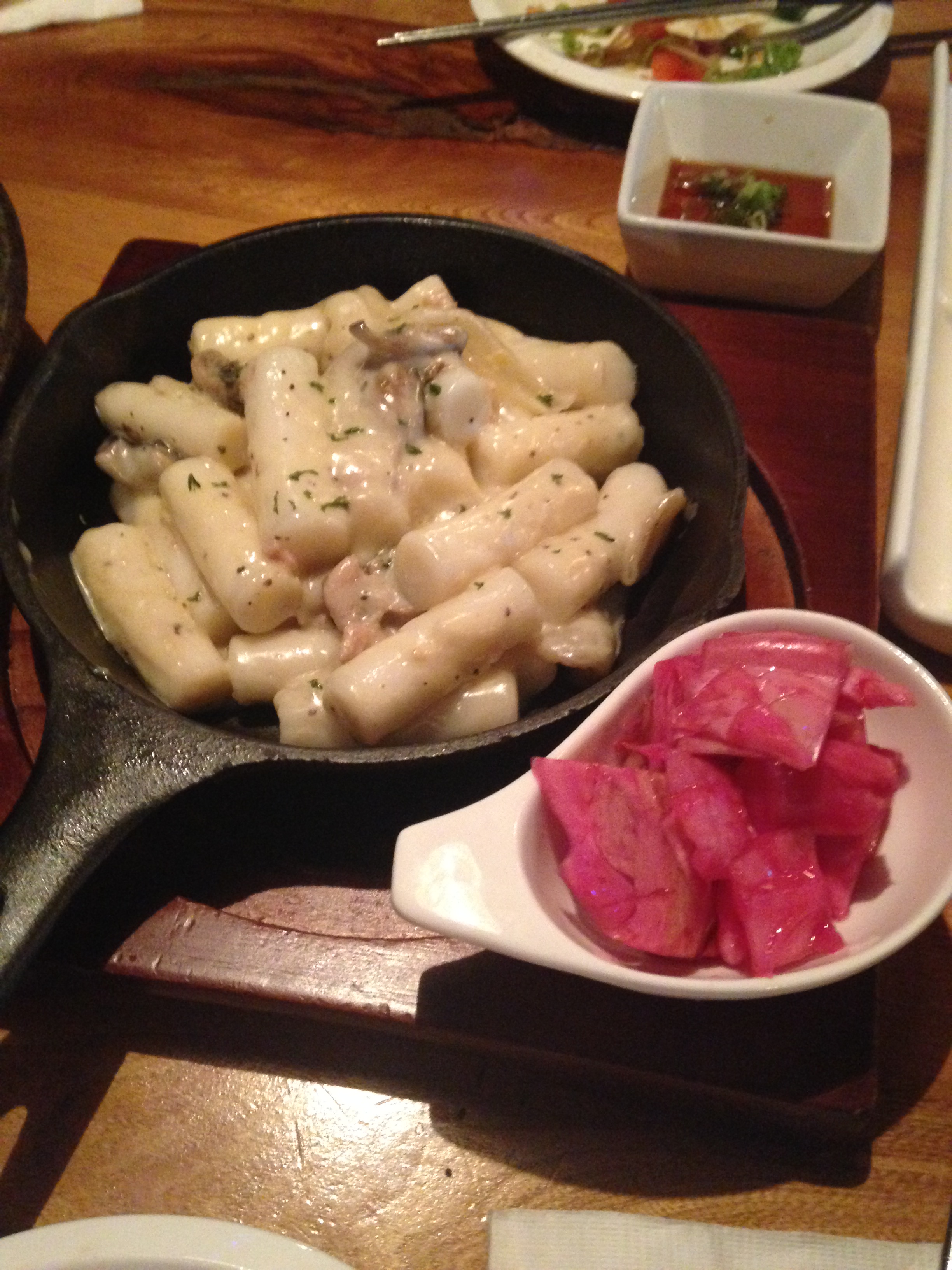
I love rice cakes and Han Ba Tang’s were no exception.  These were filthy good and reminded me of days of warming up a can of Campbell’s mushroom soup after school which was well in line with the evening’s theme of reminiscence.

Creamy Rice Cake $10

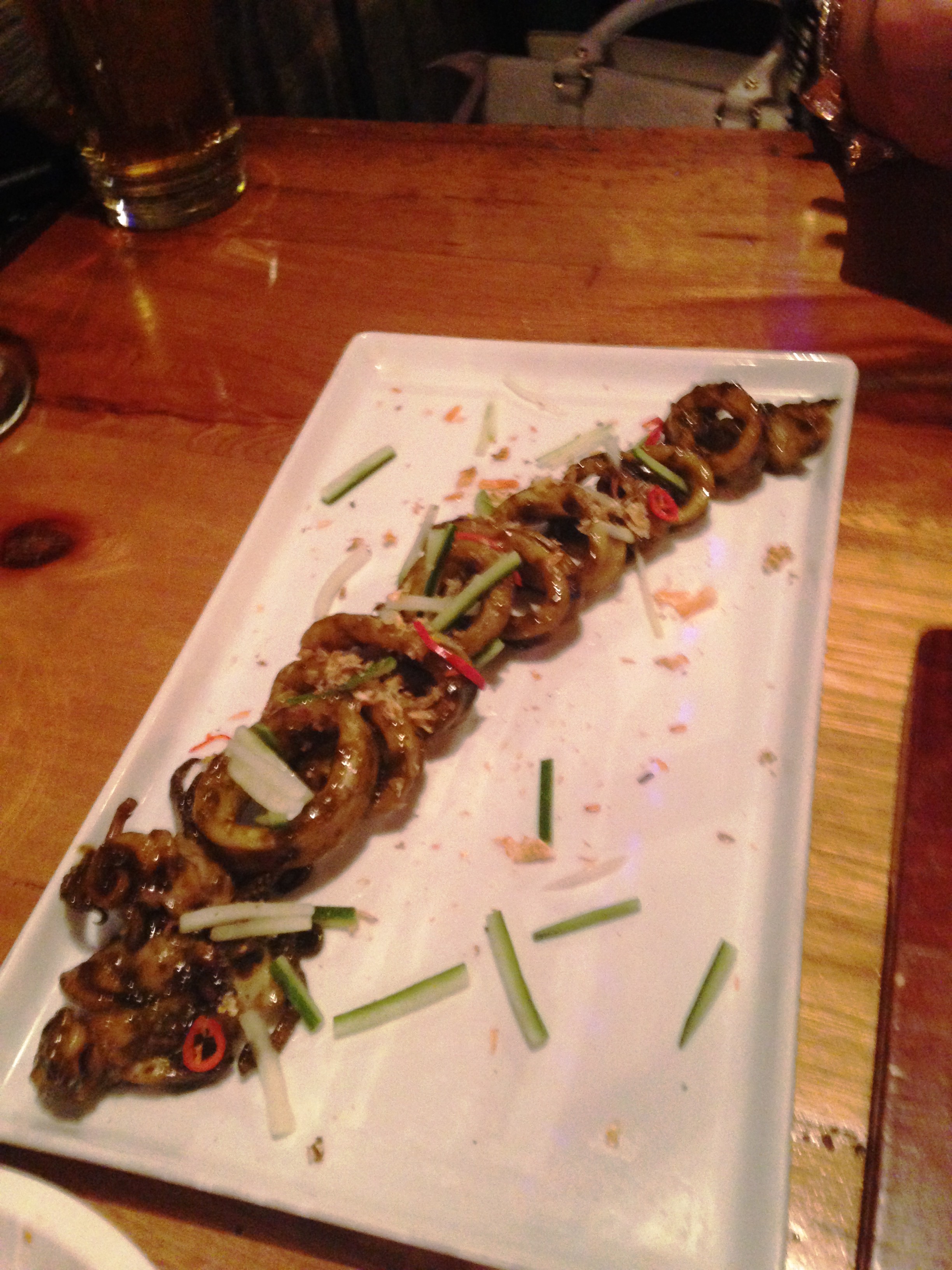
Finally, we ordered the black calamari which was coloured with a roasted seaweed sauce,further seasoned  with baby dried shrimp  and garnished with cucumbers.   The calamari was cooked well but it was little too much fish on fish flavour.

Black Calamari $11
Black Calamari $11

My Take

Before fall foraging became cool, Korean was all the rage which saw Han Ba Tang and other snack/bar food joints vault up the charts. Traditional soups, rice cakes, pancakes,  tacos and wings are served with both a taste and an environmental twist. Instead of the flat surroundings of some the College street eateries, most of the new places offer fancy drinks, loud music and a very North American vibe. There’s a fun, thoughtless innocence to these places which is often exemplified by…let’s say naive bartenders who need a manual to make a drink.  One can only imagine what would happen once the Karaoke machine goes full throttle and  “Crystal Chandeliers” by Charlie Pride fills the air.

In the end, Han Ba Tang is a bit quirky, a bit trashy and a little fun.  The tacos were a bit of a mess but otherwise the food was good and not too silly of a price. Although I don’t think it’s a 4.7 on zomato, it sure as hell beats heading to the Pagoda with a crooked haircut.


Han Ba Tang Menu, Reviews, Photos, Location and Info - Zomato
 

Canoe: Celebrating Canadian cuisine for 20 years and still (relatively) hipster free

Canoe, the flag ship of the Oliver and Bonacini empire, has spent the last 20 years highlighting the broad spectrum of fare this expansive country has to offer.  So, not surprisingly, its 20th anniversary hoopla centred around a $100 tasting menu celebrating  Canadian fare. There is a short video on their website highlighting some the principles which have driven their philosophy for the last two decades.  Needless to say, I was excited to experience their take on coast to coast cuisine.

In addition to making Canadian food cool, I appreciate the fact that Canoe is relatively hipster free.  Perhaps it’s the fact that it sits in the middle of the financial district or maybe it’s because it’s located 54 floors up with a swanky view as opposed to in a broom closet overlooking a spray painted alley. Majestic penthouse views, after all, suggest a certain societal hierarchy and we can’t have any of that.   Sure, Canoe has its share of odd patrons, especially during summerlicious and winterlicious celebrations where every penny pinching socialite makes themselves king and queen for a day, usually at the expense of the staff but it does have a magically low hipster:non-hipster ratio.

The night started with bread served with a peanut (from Ontario) butter laced with local honey.

Ontario Peanut Butter

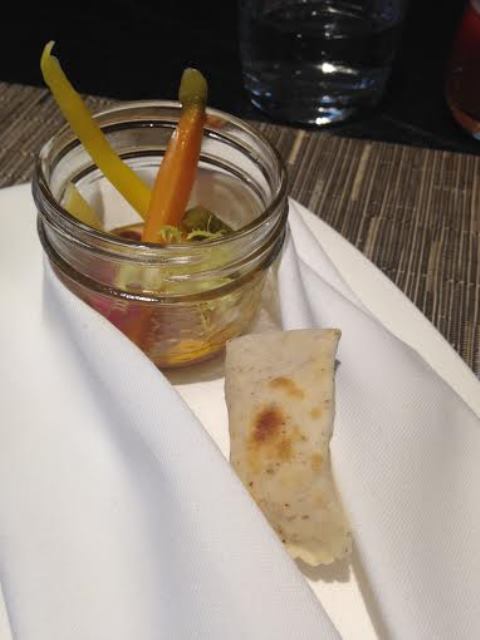
The mason jar paid homage to the art of pickling which was has evolved from a necessary form of food preservation (especially in countries with volatile climates) to a cool one.  In this case, it was a simple array of carrots, beans and pickles atop a fois gras mousse.  A little sweet and sour with a combination of crunch and velvet is always a good start to a meal.
Mason Jar (Pickled Veg with Fois Gras Mousse)

Next was the lobster carpaccio. Lobster is one of the crown jewels of Canadian protein and the chefs at Canoe detoured from standard preparation techniques to offer an east meets far east appetizer. The chef explained that pounding it thin along with a short sous vide cook was an ideal technique to remove the textural barriers that normally exist with raw shellfish while at the same time maintaining its fresh flavour.  It was made to look pretty with an array of greens and bright screech sauce (a twist on traditional Marie Rose or seafood sauce) and to taste pretty with a subtle acidity and a sesame cracker.

Lobster Carpaccio
Lobster Carpaccio

From the east coast to the shores and plains surrounding Hudson Bay came the next dish; forest lasagna.  Combining rabbit with a cornucopia of intense and native earthy flavours such as mushrooms, heartnuts and the very unique caribou moss was, as my dinner mate stated, “Canada on a plate”.  It was finished with an evergreen mornay sauce which added a paradoxical richness to a dish reflecting one of the more barren parts of Canada. In my opinion it was the dish of the night mainly due to the unique use of unorthodox yet truly Canadian ingredients.

Forest Lasagna
Forest Lasagna

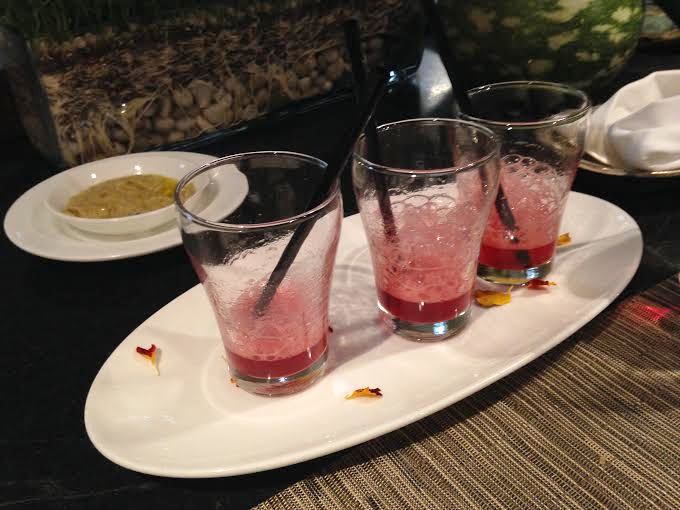
I have driven by my share of cranberry bogs on trips to Northern Ontario, so I was pleased to see that the mid-meal  palate cleanser was a foamy Muskoka cranberry cream soda.  I was at the chef’s rail, so it was interesting to watch the urgency in the pour and delivery to the table before the froth faded to nothing.  It was more sweet than tart and somewhat reminiscent of the my childhood reward of drinking Pop Shoppe cream soda from a clear bottle.

Muskoka Cranberry
Muskoka Cranberry

For the main, I opted to travel back to the east coast and all the way to Fogo Island for some jigged cod (I avoided the venison due to an ongoing promise I’ve madae to lay of Bambi for a while…grrrrr). Perfectly seared, it was served with a tender crab boudin (white sausage) and seasoned with  flavours of the sea including ocean salted potatoes and pickled seaweed. It’s probably in my head but I think there is something cool about eating ocean salted potatoes  Whereas the lasagna was  Canada on the plate, this dish was the Atlantic on a plate…and it was delicious.

Jigged Cod and Crab Boudin

Fighting the urge to go down the sickly sugary street of  butter tarts or sugar pie,  the 100 km squash dessert was the polar opposite. The moderately sweet squash tethered some of the more extreme flavours found in the savory seeds/grain and the house made ice cream.  The cattail crepe was nestled among the other earthy offerings and was simply phenomenal.

100 km Squash
100 km Squash

My Take

Canoe’s ode to twenty years of Canadian food was spot on without the need to gravitate to more pedestrian and recognizable food choices like pea soup, poutine or tourtiere.   Each dish had treasures hidden within the plate’s topography which made the experience an enjoyable exploration of our country’s blueprint.

Canoe could make the claim that it served Canadian food before Canadian food was cool. With the advent of Toronto restaurants such as Antler and Borealis, Canadian food is emerging as the newest trend.    Hipsters are already dressed for it and the thought of foraging for nuts and seeds as a means of sustenance seems well in synch with their philosophies. In fact, it may actually provide more of a purpose to their normal process of walking around aimlessly looking for bright lights and bourbon. That said, if they want to portage up to the 54th floor of the TD building they will need to brush up with the suits on the way so I suspect this won’t happen anytime soon, even if Canadian food is deemed  the new Korean.  As for the Canoe 20 menu, based on the articulate  presentation, taste and the respect given to traditional and non-traditional homegrown ingredients, I have to give it an eh.

Canoe Menu, Reviews, Photos, Location and Info - Zomato

Food Deserts: The Comestible Topography That Brought Unilever to Its Knees

I recently participated in a project called #mytomato which was sponsored by Hellman’s.   The point was to bring awareness to the concept of food deserts which can be loosely defined as geographical  regions which have limited availability to fresh, quality produce at a reasonable price.  Food deserts are a component of a broader issue called food insecurity which is loosely defined as  the inability for a person to buy the food they want to buy when they want to buy it. It’s the mother who chooses evaporated milk instead of formula for her baby because it is all she can afford.  It’s the father who can’t buy ground beef anymore because the price has doubled in the last 2 years and he needs to pay rent so it no longer fits in the food budget on a regular basis.  This is not the same as a decision to not buy a cut of steak because it is too expensive. The difference is choice.  I could buy the striploin if I wanted to but the decision not to is more of a value assessment than one out of necessity.

The #mytomato campaign involved the transformation of a GTA grocery store into one more reflective of a food desert experience.  As a participant, I was asked to enter the store and react to what I saw. The produce was scarce, of questionable quality and priced through the roof.  Among the limited choices was a $69 watermelon and tomatoes priced at $18.00/kg.  A subsequent interview allowed me to state that I would have a hard time feeding my family the way I wanted to if this what was available on a regular basis.

Teaser for the Food Desert Real Food Film

The campaign launched on facebook, twitter and youtube with reasonable fanfare.  There were comments reflecting sides of the fence. On one side there  was sympathy for the situation whereas others suggested that the ridiculous prices reflected supply and demand, meaning that if people aren’t interested in buying fresh tomatoes they won’t which raises the prices for those who do.  Another keen observer quoted the price of tomatoes in their community but also cited  the price of a jar of Hellman’s at $6.49 which is significantly higher than what you would see if a Southern Ontario grocery store and points to the fact that it isn’t only produce prices that are affected by geography . Then, as quickly as it started, the campaign vanished.  The facebook comments stopped and the youtube clip is now unviewable and listed as private.  When I inquired about the reason for the rash cessation, I was told that a few retailers objected to the campaign so it was terminated.

(Don’t Bother…you can’t see anything)

I got thinking about this and  a number of interesting issues came to mind which merit a discussion.  There is the clash of big business versus big business, the issue of convenience versus necessity, the responsibility of government or other agencies in the regulation of food prices and the acceptability of corporate involvement in campaigns which deal with public health or social issues.

1. Big Business versus Big Business

Hellman’s parent company is Unilever, a multinational conglomerate who produces and markets some of the most recognizable brands across most sections of the grocery store. As a result, there is the need for Unilever to work with these retailers to ensure that they get ample shelf space and a strong visual presence in a highly competitive environment. That said, I imagine the saying “Don’t bite that hand the hand that feeds you” enters the discussion. If Hellman’s #mytomato campaign suggests that the retailer is even partially responsible for the inflated price of poor quality produce, then there could be a harsh retaliation including the omission or displacement of Unilever products from shelves.  We are not talking small mom and pop shops either.  The big three (Loblaw, Metro and Sobey’s) have an infrastructure in place which services everywhere from downtown Toronto to remote communities across Canada.  As a result, pissing them off may have ramifications far beyond a few towns speckled above the 60th parallel.  Nobody wants to loose the opportunity to have their mayo shelved at eye level after all.

2. Convenience versus Necessity

We live in a society where convenience has evolved into necessity.  It also comes at a price.  If I run out of bread at 11 at night or don’t want to make the long haul to the grocery store during the day, there are at least three convenience stores within a kilometre or two of the house which will gladly sell me a loaf of its finest Wonder bread for 5 bucks. In either situation, I have a choice.  I can wait it out or get off my ass and drive the extra kilometre to grab a loaf.  The same opportunity doesn’t exist in remote communities.  In this case, the alternative may not be a kilometre but instead a hundred kilometres. In order words, the grocery store IS the convenience store simply because it’s the only one in town. The interesting question is whether the inflated prices are a reflection of the realization there is a monopoly and that most local residents are handcuffed or the fact that the store is in a small town which means less volume and therefore lower overall sales.  Maybe it’s a little of both.  It’s no secret that a grocery business involves razor thin profit margins which in most cases rely heavily on high volume to succeed and that the only way to sustain profits in a smaller store may be to increase prices.

3. Government Responsibility

The question arises as to whether the government or some other organization should be responsible for regulating food prices across the province or country. I suspect most would argue that we do not need big brother to monitor the price of a tomato.  Sure, affordable produce would couple nicely with the numerous (and generally unsuccessful)  public education strategies geared at increasing the population’s fruit and vegetable consumption.  I find mundane strategies including Canada’s food guide lose steam when a person is asked to spend beyond their means or purchase unavailable foods to ensure a variety are included in the diet.  I have to disagree with those who suggest that regulation of food prices is impossible.  If there was financial incentive to do so, I’m sure the government would not hesitate to employ an infrastructure to ensure it got its fair share. Think of beer and alcohol sales. The price of a case of beer is the same whether you live in downtown Toronto or in Red Lake, Ontario.  Beer is heavy, boxy and requires refrigeration yet these burdens of transportation doesn’t add to the price in remote communities.  Maybe it has something to do with the fact the government scoops a tonne of revenue with every case sold. Since produce isn’t taxed one can speculate the urgency to regulate produce (or even food) prices in general is less than a priority for a cash-strapped government. It is cheaper and less difficult just to run ineffective healthy eating campaigns through public service announcements than it is to implement tangible policies changes which might actually result in behavioral change.

food guide
Health Canada’s Answer to Food Deserts

4.  Corporate Involvement in Public Health Campaigns

The last argument is whether or not big corporations should even be involved in health promotion or campaigns. On one side, I have read numerous criticisms of Hellman’s investment in its real food movement.  Some question how real mayonnaise actually is.  On the other side, supporters feel that big business should be obligated to funnel resources into strategies which potentially better society as a whole.  That said, philanthropy rarely comes with no strings attached and I’m not sure there’s a problem with this.  I guess the bigger question is where to draw the line.  A hands-off financial sponsorship? A partnership with third party consultants?  A jump into bed as long as the outcome is good relationship? I think delving into this at this point  is beyond the scope of this particular entry blog  (I think I’ll tackle this one separately)  but it is ” real” food for thought.

My Take

A little over a month and a half ago Hellman’s launched the next installment of their real food movement which involved a closer look at food deserts which are defined as areas in Canada that have limited availability to fresh and affordable produce on a regular basis.  As quickly as it went up it came down and now has all but disappeared presumably due to pressure from retailers who took offense to Unilever’s finger pointing.  In other words, addressing food deserts essentially caused the biggest consumer product company globally after P&G and Nestle to drop to their knees and assume the fetal position, presumably over fears that they would lose prime real estate in the condiment section.  This makes me concerned that any resolution to the problem of food desserts is nowhere in the immediate future. Big companies will simply abandon such fruitless endeavors and replace them with smiling celebrity chefs handing out tomatoes at food fairs (which I’m sure goes over well with those who are selling deep fried dough). Given relatively lower sales volumes, retailers in remote communities  will continue to stick to a supply and demand system to ensure their thin profit margins are just a little thicker . Government will continue to address the issue by using money generated from liquor sales to produce colourful sheets to remind us that fruits and vegetables are an important component of a healthy diet while they rot in produce bins due to exorbitant cost and poor quality.
I don’t know the solution for food deserts. Retail subsidies by either the government or by companies seems feasible, especially if funneled through the big grocery chains.  An issue might be the need to negotiate with franchisees but perhaps it can be offered with incentives in the same way  weekly flyer specials  from the parent company work.  Maybe a coupon system specific to produce could be created.  I would hate to compare this strategy to food stamps but it may be the easiest way to facilitate and specify corporate and/or government investment in this initiative.  Plus, it would be an interesting social experiment and one which could  test the validity of the famous Field of Dreams catch line “If you build it they will come” since one of the biggest arguments against providing fresh, affordable produce is the speculation that it would just sit there anyway because consumers would still opt to spend their food budget on other choices including non-perishables.

In the end, Hellman’s #mytomato campaign was a short lived mirage in an expansive food desert.  The intent was good but was quality quashed by point of sale retailers (likely related to the big three) who likely feel handcuffed by an inability to offer fresh fruits and vegetables without cutting into profit margins and ultimately their own livelihoods.  The solution is not evident but at the same time the problem shouldn’t fade into the sunset by pretending it doesn’t exist or by succumbing to the perception that if a powerful multi-national company like Unilever can’t tackle the problem then nobody can.


I Didn’t Get Crabby but I Managed to Get Bitter at Oxbow Public Market in Napa

Almost every city, big or small, boasts a market and Napa is no different.  Shortly after arriving in town, I headed down to the Oxbow Public Market  to check it out and grab some lunch at the bib gourmand rated C Casa.  Oxbow is a mid-sized indoor market with a combination of shops and restaurants. You can get anything from charcuterie to ice cream.

My biggest target at Oxbow was C Casa, a bib gourmand rated joint featuring unique tacos and other fusion Mexican fare. I was giddy in line in preparation for my  $9 fresh crab taco.  Sadly, the crustacean was not in stock and I had to resort to other options so I settled with the pork carnita tostada with white beans, corn relish, poblanos, micro greens, romaine, lime crema and cotija cheese  ($5.75) and the rotisserie duck  taco with spinach, red onion, goat cheese, oranges, cumin vinaigrette, avacado crema and cilantro  ($8.00).  These were expensive tacos so I was happy to see them arrive with a heaping pile of fillings. The pork tostada was a mess as there was no graceful way to eat it. The beans were such a smart addition and the crema was equally intelligent. The thought of duck and citrus was a little frightful  but it worked reasonably well.  It was less like a taco and more like a spinach salad on a tortilla.  There is a good variety of local pints as well. Beer and tacos are a beautiful couple.

Pork Carnita Tostada ($5.75) and Rotisserie Duck Taco ($8.00)


After barely finishing the Mexican monstrosities, I strolled around the rest of the market in complete awe.  It was like an angel met me in my sleep and asked me “If you could build a market, what would  be in it?”.  My answer would be an oyster house, a spice shop, a kitchen gadget place, a butcher, charcuterie, ice cream and a fancy place where I could get bitters and shrubs to tinker with my own cocktails at home.   Voila!  That’s Oxbow Market.  In particular, let me focus on the last place.  I have gotten a little more experimental with my homemade potent potables and my struggle has been the inability to find bitters outside of the standard angostura.  Many of the Toronto bars brag about walnut, green tea, cherry bourbon and other fancy additions to their old fashioneds and it pisses me off.  The Napa Valley distillery has the largest variety of bitters I have ever seen.  I was a kid in a candy store as I wandered around  aimlessly thinking of the adultery I could commit but combining a number of these flavours with a bottle of Bulleit bourbon. Ironically, it was the first time I realized a significant number of the bitters were produced by Dillon’s, the Niagara distillery a mere 160 km away from my house.

Oh ya…they have a bunch of organic crap at Oxbow too.

My Take

If you go to Napa you most definitely should drink wine but you have to come here!!!!!! I have to admit knew nothing of the Oxbow market prior to my Napa visit. Once there, however, I entered this nirvana which contained all my vices under one roof. Although I didn’t indulge in every one, I got to sip pints, eat tacos, taste bitters, smell spices, stare at striploins and sleep well afterwards. C Casa was probably deserving of bib gourmand status but did not serve the best taco I ever had (and they didn’t have crab).  They were busy and overfilled but had good flavour.  For any foodie,  I highly recommend a dreamy wander through Oxbow Public Market. Although C Casa made me a little crabby, I’ll save my bitterness for  Dillon’s on Tufford road in good old Beamsville, Ontario.

Click to add a blog post for C CASA on Zomato


Notching my Bedpost with Uncle Tetsu while Cursing a Budding Witch

I woke up early while in Toronto so I decided to take a quick jog over to Uncle Tetsu’s to try and secure an elusive cheesecake.  Every time I have strolled by, regardless of time of day, there have been no fewer than 20 people in line. So I was pleased to show up to see a mere 5 people out the door.

I was in absolutely no hurry so I decided to kill the time by engaging in some good old fashioned people watching. Apparently a few others were in more of a hurry than I was. One woman stormed in with some magic ticket stating it should put her to the front of the line.  They quickly dismissed her and she wandered out and decided her place in line was right in front of me. I typically don’t sweat the small stuff so I mumbled something under my breathe and life went on.

Meanwhile, the employees were busy in a very methodical baking process. On one side was the careful measuring of the flour and ridiculous amount of butter for the Madeline (honey) cakes.  On the other side a team of four or five carefully constructed the signature cheesecakes.  In a way I felt like I was at a zoo. Patrons were pressing their noses against the plexiglass hoping to get a better look at the mixing bowl.  Other were snapping pictures of the branding of the cheesecake like it was the hatching of a peregrine falcon. The purchasing process is a bit like Seinfeld’s soup nazi.  You approach the cash, state your order, pay, get your product and leave. It is cash only and there is a limit of 4 madeleines and 1 cheesecake which almost everybody orders and comes to $17.55.

As a batch was released I did the math and realized I was going to miss it by one cake. Part of it was the miserable b*@^h who decided her place in line was in front of me (who I subsequently wished bad karma upon via a facebook post).  The other reason was the number of people bringing their slumber-eyed two year old kids as customers.  So a family of four can walk in holding their kids up like Kevin Kline in “Weekend at Bernie’s” and walk out with a quartet of cakes.  In the end, despite my early optimism, I had to wait 20 minutes for the next batch which means in the end I ended up waiting nearly an hour.

The madeleines  were quickly consumed by my kids.  I managed to get a bite or two and concluded they were quite average. The cheesecake was part of a lunch at my dad’s and came with great anticipation. If anything it was surprising.  The fluffy texture was in between a flan and a cheesecake and taste wise had hints of both.  There was nothing wrong with it but I guess Uncle Tetsu doesn’t see the need for ridiculous North American additions such as fruit or some kind of a crust.

Madeline $2.22 each or 4 for $7.55 taxes in
6 inch Cheesecake $8.88 or $10 taxes in

My Take

I have been known to partake in ridiculousness when it comes to food and this is no exception.  The phenomenon of waiting an hour in line for a cheesecake while surrounded by people who take pictures like it’s Niagara Falls is near the top of the list.  I wasn’t expecting a miracle in a box and I didn’t get one either with the madeleines or the cheesecake. What I got was a tattooed piece of Japanese folklore which allowed me to carve another notch in my bedpost of culinary conquests within the GTA. It also reaffirmed my Taurean tendency to hold a grudge because I sure as hell hope she dropped her cheesecake on the way to her car, broom or whatever mode of transportation she arrived with.

Click to add a blog post for Uncle Tetsu's Japanese Cheesecake on Zomato

McRamyun (or Ramyun?) : There’s a Good Chance Ronald Showed up with a Louisville Slugger

I was on a lunch break recently and decided to check out Baldwin village for lunch.  Although I was still lamenting the closure of Yakitori Bar (i still swear they had some of the best soup going), I was intrigued to try McRamyun, the new ramen bar that occupied the space.

I knew little of the place when I walked in but appreciated the fact that a ramen bar exists which doesn’t involve the hot, tight quarters that exist with similar eateries elsewhere in the city. It has maintained the interior of Yakitori bar complete with a large bar and spacious tables.

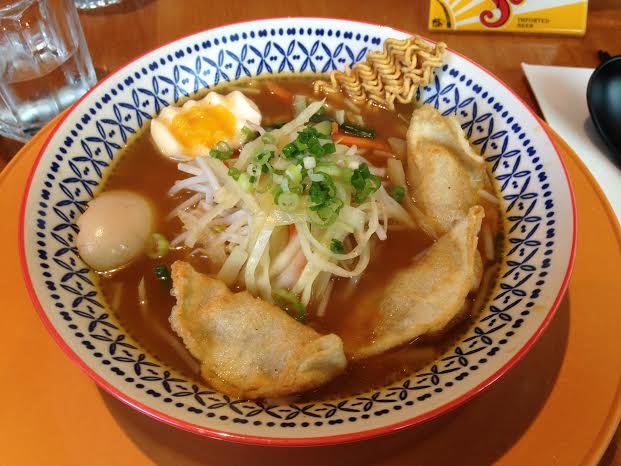
At first glance it was clear the menu offers one of the largest variety of ramen (almost 20) in the city. In addition, you can choose your own adventure by adding your choice of toppings unlike other places tend to dictate the condiments of each bowl. Usually I order dumplings and soup as a benchmark in ramen joints, so i killed two birds with one stone and ordered the mandu ramen which offered the dumplings right in the soup. As I was waiting, I went to the washroom located in the old Odd Seoul space next door.  That’s when I made afrightening discovery.  The room was filled with skids of packaged ramen noodles.  I felt like I was in a university dorm room.  When I returned to the table (the washrooms were quite nice by the way) the soup arrived.  The broth was thin and spicy and the noodles originated from one of the packages in the back room.  The mandu were deep fried prior to being thrown in the soup which I found odd from a texture perspective.  They did not have remarkable flavour. The broth lacked the complexity of other places and was seasoned primarily by salt and heat. The egg (available for an additional  $0.50 per half..I got a whole egg) was cooked nicely and was the best part of the dish. They forgot the slices of pork belly I ordered so I can’t comment. It would have been and extra $2.49 which would have made the total price of the ramen bowl a staggering $12.50, a price which would make David Chang shake his head.

Mandu Ramyun $8.95 plus $1.00 for egg (pork belly missing)

My Take

Burgers and ramen are probably the two hottest trends in the Toronto right now.  The burgers range from patties smashed on the flattop to those stuffed with short rib and are price accordingly.  Until now, most ramen has been prepared according to traditional recipes complete with homemade noodles and thick pork broth which has simmered for hours.  Sure, I’ve made all kinds of ramen; from following an old school recipe to cracking open a dried package after a drunken night out in university but I never thought I’d see the latter served in a restaurant.

Then it made sense. I should have clued in that the name McRamyun said it all.  This was fast food…the McDonald’s version of ramen.  What confused me, however, was the fact that prices were not much lower that traditional ramen.  I mean a quarter pounder isn’t $20, right?

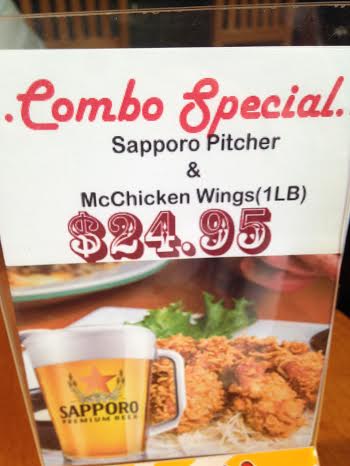
I looked at the table tent on the table, saw the following sign and laughed.  How do they get away with this?

Clear copyright infringement

A Sapporo pitcher and McChicken wings for $24.95?  McChicken? The signage outside, the menu, the packaged food..everything made me think that at any minute Ronald McDonald would show up with a Louisville Slugger ready to kick ass and take names later. Interestingly enough, there was a profile picture update on the restaurant’s webpage two weeks ago which displayed their new logo which simply said  Ramyun.  I wondering if that change was proactive of may have had something to do with a few broken windows and a pissed off clown.
Click to add a blog post for McRamyun on Zomato

R&D: Rebel and Demon, Research and Development, Rad and Deficient

In a previous blog, I outlined my Masterchef tryout in some detail.  Despite my failure to impress the producers, I watched the show and was happy to see Eric Chong win.  I was equally happy to see something tangible come from his win;  a new restaurant in the perilous region of Chinatown.  R&D is a partnership with the mercurial Alvin Leung, who’s blue hair makes old ladies and smurfs alike quite envious.  The restaurant’s concept is one of polarity and contrast. Our bubbly waitress promised flavours which ran the gamut of tastes and flavours with every bite.  The name R and D refers to the Rebel and Demon personas of the owners and is a play on the fact they were both engineers before finding their true vocation.  Adding to the polarity is Eric’s calm demeanor coupled with the mad science antics of his partner.

I asked the enthusiastic waitress for menu recommendations.  She recommended pretty much everything on the menu but in particular raved about he CSB buns. They cook them hourly and getting one might be synonymous with scoring a Black Friday deal.  Once out of the oven, the waitstaff wrestle for them in the hope they can secure them for the patrons at their tables. I drank the Kool-aid and insisted that we secure some of this precious loot. Did we manage to get them?????

STAY TUNED

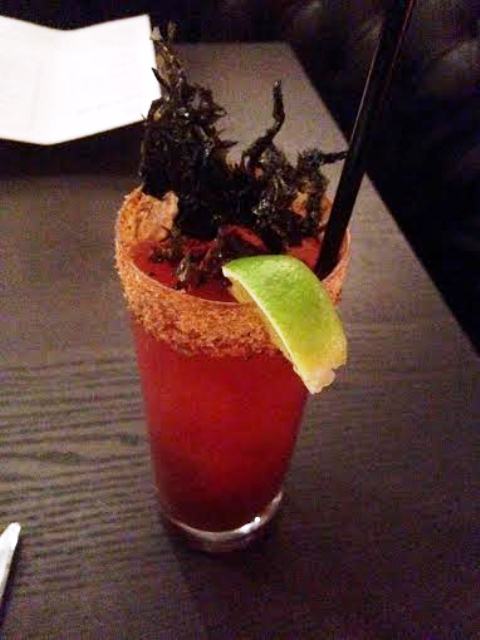
The drink list comprises of Asian inspired potent potables derived from a collection of traditional cocktails.  The Whisky sour is splashed with  lemongrass, coriander, pepper and yuzu liqueur.  The pina colada is served as boozy bubble tea. The 510 ceasar (which I ended up ordering), was made with garlic and mushroom infused vodka and seasoned with hoison Worcestershire sauce.  Mushroom flavour was prominent and heat from the chili sauce was a little shy. The drink was topped with Nori which added a pleasant element of unami.  All in all, it was a good Caesar but was a little small in volume which probably helped to intensify the aforementioned flavours.

510 Caesar $14
510 Caesar $14

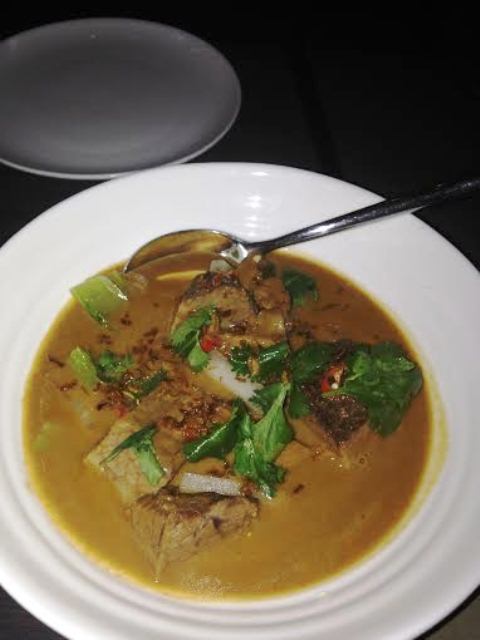
The first dish to arrive was Eric’s Curry.  Beef brisket sat in a pool of curry sauce and mustard greens. It was brilliantly unique.  A little salt and sweet and a lot of sour and heat made this great to eat (that’s poetry for you left brained science types).  At the time, the dish came with no medium to absorb the sauce (a true engineering flaw) which really was shameful considering how good the sauce was. Maybe we can call it an early oversight since  it appears based on the website the dish now comes with coconut rice. Probably the best dish of the night.

Eric's Curry $20
Eric’s Curry $20

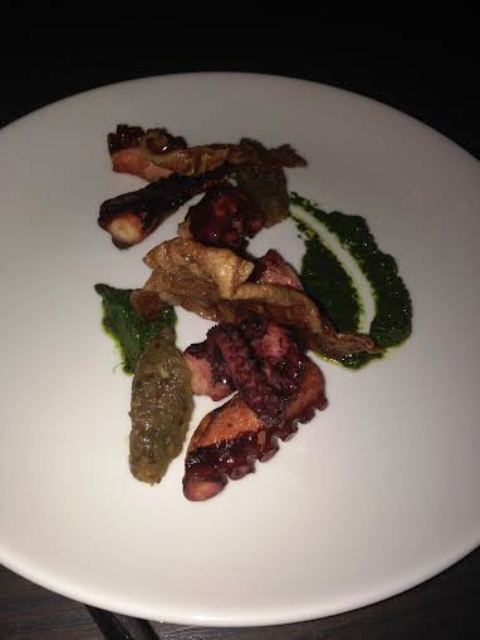
Next was the octopus which was served with eggplant and choy sum chimichurri. The presentation was a little sad but the octopus was nicely prepared and finished with a decent char.  The eggpplant was clever as a replacement to the normal routine of potatoes or olives and the chimichurri was  deliciously unorthadox yet had a familiar flavour I couldn’t quite pinpoint but wanted more.

Octopus $14
Octopus $14

Shortly after we received the Tom Yum Little Dragon buns ($6). I imagine that Thai flavours in a Chinese bun may be considered as engineerial as calling a soup dumpling a dragon bun but in the end they hit the mark on flavour and were a pleasant bite.

Tom Yum Dragon Buns $6

I was a little reluctant to try the lobster chow mein ($25) but my colleague talked me into it. Despite a reasonably sized  portion of lobster, it was horribly predictable and had no wow factor at all.

Lobster Chow Mein $25

The one platter were ordered was the general saunders’ chicken served with  kung pao sauce, sichuan maple syrup, and HK egg waffles.  The chicken was nicely seasoned and super moist.  The kung pao sauce was delicious and I think the maple syrup is probably an acquired taste but I took the advice of the waitress and mixed the two together which created a mixture which satisfied a number of taste sensations.  The waffle portion was a little skimpy but complemented the chicken well in their spin of this traditional southern dish.

General Sanders' chicken $25
General Sanders’ chicken $25

At this point there a bit of a mad scramble around the kitchen which suggested one thing..the buns were ready.  Although I was getting rather full, I couldn’t resist the urge to indulge and our waitress, like a trooper, emerged with an order.  The pork filling was a bit scant a certainly played second fiddle to the delicious bread.  They were delightfully warm and just a little sweet and filled my need for gimmickry nicely.

CSB Buns $8
CSB Buns $8

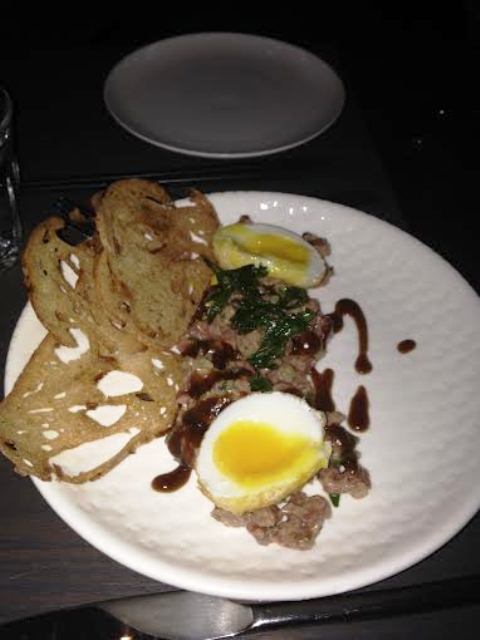
At this point I was quite stuffed but another colleague showed up and ordered the beef tartare.  The spin was the son and law egg with the sauce served on top of the beef.  I had mixed feelings about this one, probably beacuse I’m a bit of a traditionalist when it comes to this dish in particular. I think the beef should be the star and thought the sauce, although matching nicely with the egg,  masked the flavour of the beef a little too much.

Steak Tartare $17
Steak Tartare $17

She also ordered the scallop which was served with hot sauce, chinese greens and sichuan hollandaise. It was hard to put my finger on it, but the dish lacked balance.  The heat and bitterness was prominent but it lack sweetness. Maybe the thought was that the scallop would provide enough sweetness to offset the flavours of the hollandaise and Chinese greens. The scallop itself was cooked near perfectly other than lacking a good sear (which affected both its colour and what might have been a necessary caramelization). Personally, I would have kicked up the sweetness of the hollandaise or replaced it all together.

Scallops $23
Scallops $23

My Take

The Asian fusion concept of R&D is certainly a better fit for Spadina than Strata 241 was. It is a well calculated project with all the fixings of a nouveau Toronto eatery; celebrity chefs, old school rap “fusion food”.  I was surprised a bit by Eric’s kitchen demeanor.  He was extremely stoic and methodical, focusing more at the task at hand than shining in the limelight as Canada’s first masterchef winner. It’s like he was in a 2 hour mystery box challenge.  Like the show, there was a combination of great and not so good dishes. The curry was hands down the best dish of the night.  The chicken, octopus, buns and tartare were more than acceptable and the lobster chow mein and scallops were a bit of a train wreck.  Also like the show, there was gimmickry and hype lead by the promise of extreme flavours with every dish that didn’t always come to fruition.  Much like a television show, the success of R&D will depend on loyalists who will continue to go after trying it once for the novelty, Eric’s ongoing commitment and whether or not people will be able to tolerate Alvin Leung for anymore than a season of Masterchef.

R&D Restaurant on Urbanspoon


I Know I’m as White as the Adrak Duck but Cut Me Some Quack

I was meeting a customer for a dinner in the North and since we both agreed on Indian, he suggested Adrak in Richmond Hill.  So, I hopped on Open Table and made a reservation for the following week.

I’m not overly familiar with Richmond Hill so I needed to type this one into my iPhone.  With the help of Siri I was directed into an abandoned parking lot with a small sign stuck in the ground  indicating that the restaurant was somewhere in the vicinity.  After parking, I walked around to the front of one of the buildings and found the entrance rather easily.  It’s quite spacious, complete with a glassed off area housing tandoori ovens pumping out meat and bread at a feverish rate.  There is a unique cocktail menu which brings flavours of the Southeast into a potent potable.  Although I was tempted, I was deterred by the need to drive back to airport area afterwards.

Although  Adrak means ginger in Hindi, the minute I heard the name of this restaurant I thought of the Aflac duck. This mischievous water fowl made headlines when the absolutely obnoxious Gilbert Gottfried was fired as the voice for making a series of inappropriate jokes related to the tsunami in Japan years back..  Since then, the duck has continued to get in trouble in commercials  by most recently attending a yoga class so he can shamelessly stare at women’s asses in tight pants.

Since the Alfac duck is really white and the name sounds like Adrak, I would like to propose that the term Adrak duck refer to any really white person that walks into a ethnic restaurant and either gets questioned about their food choice or their level of spice.  I have been the victim of this practice numerous times and just think I’ll start belting out “Adrak!” in a duck voice whenever this happens. Consider the following examples.  I recently walked into a Thai restaurant with my daughter and we ordered fresh spring rolls with pork rind in it.  The waitress raised an eyebrow and asked if we were sure we wanted pork rind because  it was skin.  Although I was tempted to yell “Adrak!”, as much as I hated to do it, I had to resort to a foodie look while stating “Yes, I’m aware”.  I also have a Sri Lankan friend I will meet for lunch on occasion.  Whether we go for East Asian or Indian, the level of spice is a discussion between the waitstaff and I with frequent glances at my friend with a “is this guy for real?” quizzical look on their face.  The assumption is the level of heat needs to be tailored to me since I’m the wimpy white guy.

ADRAK!

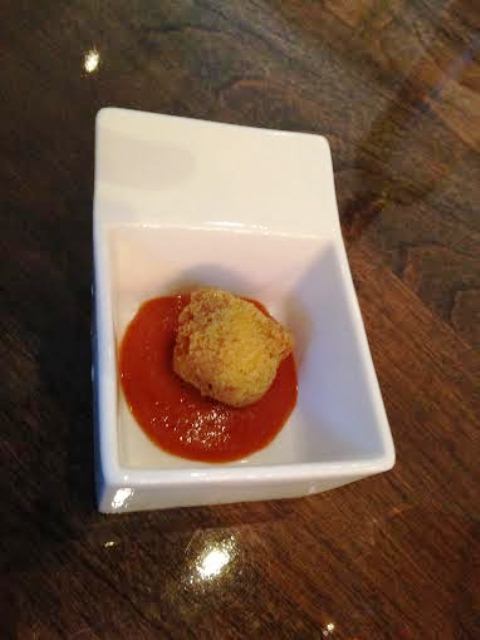
I’ve read reviews questioning the service at Adrak.  Maybe it was the fact that it was a Wednesday night but I found it prompt and courteous.  The night began with a decent amuse bouche reminiscent of arancini with saffron accents and served atop a tangy tomato sauce.

Amuse Bouche- Arancini

Tandoori Temptations

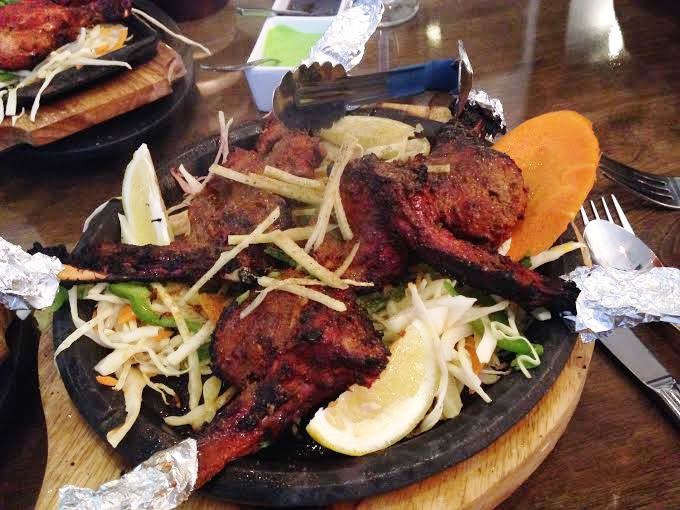
We started the night with a trio of protein from the tandoori oven; salmon tikka, bhatti da murgh (chicken legs) and chaamp taajar (lamb chops).  Each was seasoned with an array of spices, fired up and attractively served.  Before putting in the order, however, it happened.  Totally ignoring the Indian guy at the table, he looked at the two white guys at the table and asked about the spice level.  We agreed on spicy and he proceeded to inform us that Indian spice is hotter than normal spice.

ADRAK!

Even for a white guy, everything was nicely spiced and didn’t require copious amounts of water nor a call to Telehealth to digest.  Despite the extreme heat of the tandoori oven, the meat kept its interior moisture and the traditional sauces were a nice complement.

Salmon Tikki $18
Salmon Tikka $18
Bhatti Murgh $16
Bhatti Murgh $16
Chaamp $25
Chaamp Taajar $25

Next, we decided on a few curries. At the recommendation of my guest, we ordered the Dal Makhani (lentil) and the less traditional Adraki mushroom dishes.  He also recommended the Romali Roti as opposed to Naan.  I added the Matter Paneer (pea and cheese) and the smokey Bangain Bharta (eggplant).   Quite confident with our dominance of the tandoori, I figured spice wouldn’t be an issue this time but in sitcom fashion, the waiter reminded us the spices are more prominent in curries so we should might want to bring it down a notch.

ADRAK!

The lentils were delicious but extremely rich driven by the background taste of lots of butter.  One of my favorite characteristics of a curry is the consistency and I found the mushrooms  a bit disjointed.  The flavours were fine but just didn’t blend as nicely as I hoped.  The peas were spot on; a nicely balanced mix of sweet and tangy with a perfect texture.  I thought the eggplant was decent as well although not as good as the dal or matter.  Once again, the spice level was quite acceptable, even for a tongue flexing Caucasian.

While waiting for the curry, I watched the chef toss the roti dough like a pizza and delicately place each piece on a heated globe of stone and wait a mere few seconds for it to heat up and then skillfully fold it into a basket for the table.    Now I can barely eat with a fork, so using the roomali roti ($5) as a vessel  is always a fun adventure which usually ends up with me spilling something on my shirt or lap.  I’d probably be safer with some basmati and a fork but what’s the fun in that and plus, I’m not a huge fan of rice.

mushroom
Adraki Mushroom $14 and Bangain Bharta $14
Dal Makhani $12 and Matter Paneer $13

My Take

I’m not suggesting that Adrak did anything wrong by questioning the spice levels for a couple of white dudes but I find this is a common occurrence in a slew of ethnic restaurants.  I’m sure it is quite common to have complaints from some clown who thinks he is scary spice come in only to be brought down to baby spice level with one bite of a samosa.  At the same time I should point out that I’m not interested in spice that kills the flavour of the food for the purposes of bragging rights but I do like things which are authentic. That said, I’m tempted to stand up and yell “I did it in two minutes and thirty-seven seconds” hysterically as I rip off my shirt and reveal my “I survived the Blazing Wing Challenge Buffalo Wild Wings Shirt” tee to silence the critics.

Adrak was a decent experience in modern Indian food. The service was good and prices were not ridiculous but a little on the high side  From the open kitchen in which one can witness dough tossing and hot tandoori ovens to the large variety of  traditional and not so traditional curries, any fan of Indian food will find something to satisfy their palate whether your tastes could be better described as  baby (Adrak!) or scary spice.

Adrak!
Adrak!


Adrak on Urbanspoon